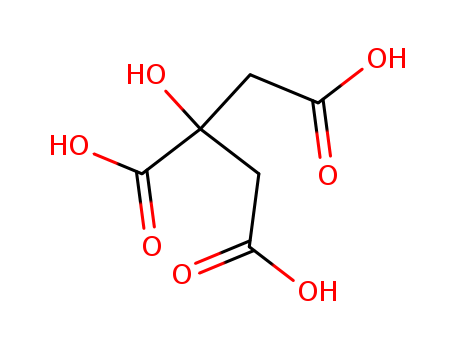
CasNo: 77-92-9
MF: C6H8O7
Appearance: White crystalline powder
|
History |
The discovery of citric acid is credited to Jabir ibn Hayyan (Latin name Geber, 721–815). Citric acid was first isolated in 1784 by the Swedish chemist Carl Wilhelm Scheele (1742–1786), who crystallized it from lemon juice.The crystalline structure of anhydrous citric acid, obtained by cooling hot concentrated solution of the monohydrate form, was first elucidated by Yuill and Bennett in 1934 by X-ray diffraction.In 1960 Nordman and co-workers further suggested that in the anhydrous form two molecules of the acid are linked through hydrogen bonds between two –COOH groups of each monomer. |
|
Preparation |
By mycological fermentation using molasses and strains of Aspergillus niger; from citrus juices and pineapple wastes |
|
Biotechnological Production |
Fermentation is the technology of choice for citric acid synthesis. Different bacteria (e.g. Arthrobacter paraffinens and Bacillus licheniformis), filamentous fungi (e.g. Aspergilus niger and Penicillium citrinum) and yeasts (e.g. Candida tropicalis and Yarrowia lipolytica) are able to produce citric acid. Due to high productivity and easy handling, citric acid is usually produced by fermentation with A. niger. For example, a product concentration of 114 g.L-1 within 168 h has been reached by cultivation of A. niger GCMC 7 on cane molasses . On the industrial scale, submerged cultivation, surface fermentation and solid-state fermentation are used. In general, molasses, starch hydrolyzate and starch are used as substrates. However, there are various studies for alternative raw materials. Solid-state fermentation of inexpensive agricultural wastes is one possibility. For example, high yields up to 88 % have been achieved using grape pomace as substrate. Lowering the cost of product recovery is crucial. Different methods using precipitation, solvent extraction, adsorption, or in situ product recovery have been described. One interesting process could be the in situ crystallization of citric acid during fermentation to improve the economics. |
|
benefits |
Citric acid is not a vitamin or mineral and is not required in the diet. However, citric acid, not to be confused with ascorbic acid (vitamin C), is beneficial for people with kidney stones. It inhibits stone formation and breaks up small stones that are beginning to form. Citric acid is protective; the more citric acid in your urine, the more protected you are against forming new kidney stones. Citrate, used in calcium citrate supplements and in some medications (such as potassium citrate), is closely related to citric acid and also has stone prevention benefits. These medications may be prescribed to alkalinize your urine. |
|
Air & Water Reactions |
The pure material is moisture sensitive (undergoes slow hydrolysis) Water soluble. |
|
Reactivity Profile |
Citric acid reacts with oxidizing agents, bases, reducing agents and metal nitrates . Reactions with metal nitrates are potentially explosive. Heating to the point of decomposition causes emission of acrid smoke and fumes [Lewis]. |
|
Biochem/physiol Actions |
Citric acid in dietary form can augments absorption of aluminium in antacids. It also facilitates the phytoremediation of heavy metal contaminated soil and can transform cadmium into more transportable forms. |
|
Safety Profile |
Poison by intravenous route. Moderately toxic by subcutaneous and intraperitoneal routes. Mildly toxic byingestion. A severe eye and moderate skin irritant. An irritating organic acid, some allergenic properties. Combustible liquid. Potentially explosive reaction with metal nitrates. When heated to decomposition it emits acrid smoke and fumes. |
|
|
|
|
Biochemical Role |
Citric acid is a 6-carbon tricarboxylic acid synthesized in the mitochondria through the condensation of oxaloacetate and acetyl-CoA by citrate synthase. |
|
Biomedical Applications |
Citrate-based biomaterials (CBBs) are biomaterials cross-linked with citric acid. These biomaterials exhibit advanced properties suitable for various biomedical applications, such as tunable mechanical properties, biocompatibility, and biofunctionality. |
|
Industrial Production and Market Demand |
Citric acid is industrially produced through fermentation. |
|
Applications |
In the food industry, citric acid is used as a food acidulant to prevent oxidative deterioration and improve taste and color in products. |
|
Emerging Applications |
Citric acid properties are being explored for new applications such as in biodegradable packaging, disinfectants, fruit preservatives, and environmental remediation. |
|
Physical properties |
CITRIC ACID, white crystalline solid, decomposes at higher temperatures, sp gr 1.542. Citric acid is soluble in H2O or alcohol and slightly soluble in ether. The compound is a tribasic acid, forming mono-, di-, and tri- series of salts and esters.It occurs in large amounts is citrus fruits, and is used widely in industry as an acidifier, as a flavoring and chelating agent. pKa values are 5.21, 4.28 and 2.92 at 25 °C (extrapolated to zero ionic strength).Citric acid is a good buffering agent for solutions between about pH 2 and pH 8. It is popular in many buffers in many techniques, electrophoresis (SSC Buffer #), to stop reactions, for biopurifications, crystallography... In biological systems around pH 7, the two species present are the citrate ion and mono-hydrogen citrate ion. the pH of a 1 mM solution of citric acid will be about 3.2. |
|
Definition |
ChEBI: Citric acid is a tricarboxylic acid that is propane-1,2,3-tricarboxylic acid bearing a hydroxy substituent at position 2. It is an important metabolite in the pathway of all aerobic organisms. It has a role as a food acidity regulator, a chelator, an antimicrobial agent and a fundamental metabolite. It is a conjugate acid of a citrate(1-) and a citrate anion. |
|
Application |
Citric acid is a weak organic acid that is known as a commodity chemical, as more than a million tonnes are produced every year by mycological fermentation on an industrial scale using crude sugar sol utions, such as molasses and strains of Aspergillus niger. Citric acid is widely distributed in plants and in animal tissues and fluids and exist in greater than grace amounts in variety of fruits and vegetables, most notably in citrus fruits such as lemon and limes. Citric acid is mainly used as an acidifier, flavoring agent and chelating agent. It was also used as a chemical restrainer particularly in developers for the collodion process and in silver nitrate solutions used for sensitizing salted and albumen papers. |
|
Aroma threshold values |
By mycological fermentation using molasses and strains of Aspergillus niger; from citrus juices and pineapple wastes |
|
General Description |
Citric acid appears as colorless, odorless crystals with an acid taste. Denser than water. (USCG, 1999) |
|
Biotechnological Applications |
Citric acid cycle Citrate, the conjugate base of citric acid is one of a series of compounds involved in the physiological oxidation of fats, proteins, and carbohydrates to carbon dioxide and water. This series of chemical reactions is central to nearly all metabolic reactions, and is the source of two-thirds of the foodderived energy in higher organisms. Hans Adolf Krebs received the 1953 Nobel Prize in Physiology or Medicine for the discovery. The series of reactions is known by various names, including the "citric acid cycle", the "Krebs cycle" or "Szent-Gy?rgyi — Krebs cycle", and the "tricarboxylic acid (TCA) cycle". Other biological roles Citrate is a critical component of bone, helping to regulate the size of calcium crystals. |
InChI:InChI=1/C6H8O7/c7-3(8)1-6(13,5(11)12)2-4(9)10/h13H,1-2H2,(H,7,8)(H,9,10)(H,11,12)/p-3
-
Biosynthesis of Ds(+)-threo-isocitric ac...
Two Burkholderia gladioli strains isolat...
-
The hydroxylation of 4-methylenetetrahyd...
Citric acid production from xylan and xy...
The absolute stereochemical course of th...
Two new acidic Nα-acylarginine derivativ...
-
The reaction between cisplatin and DNA i...
Investigation of prebiotic metabolic pat...
Thiol-containing nucleophiles such as cy...
Construction of highly efficient hollow ...
toluene

carbon dioxide

2-buten-4-olide
benzaldehyde
acetic acid
benzoic acid
citric acid
| Conditions | Yield |
|---|---|
|
With SmMnO3; at 350 ℃; Temperature; Reagent/catalyst; Catalytic behavior;
|
|
|
With Fe0.6Mn2.4O4; for 120h; Reagent/catalyst; Catalytic behavior;
|
β-D-glucose
L-valine
1-hydroxy-propane-1,2,3-tricarboxylic acid
2-methylisocitric acid
citric acid
| Conditions | Yield |
|---|---|
|
With Saccharomycopsis lipolytica; In water; at 26 ℃; for 120h; Product distribution; also in n-hexadecane medium; catabolism of amino acids by S. lipolytica;
|
ethanol
glyceric acid
mannitol
fructose
anhydroacetylcitric acid
4,7-dimethyl-coumarin
2-acetoxy-propane-1,2,3-tricarboxylic acid
triallyl citrate